
 There is a particular kind of hope that appears when young people are given the chance to work together on something real.
Not a simulation. Not a hypothetical exercise disconnected from the world around them. Something human. Something tied to the communities they live in and will one day inherit.
At a time when conversations around artificial intelligence are increasingly dominated by fear, automation, and uncertainty, many young people are searching for something deeper than productivity. They are searching for meaning, agency, and a way to build lives that still feel distinctly human.
What will make the next generation truly valuable in a world increasingly shaped by artificial intelligence? And perhaps more importantly: how can the next generation use AI to create positive impact in ways humanity has never seen before?
Those questions inspired the creation of CARE360™.
Founded by Penny Stein and Ira Kaufman, this Virginia-based initiative sits at the intersection of leadership, civic innovation, ethical AI, and human development. But its origins are personal. Stein’s three children and Kaufman’s two are all now young adults navigating the same rapidly changing world confronting an entire generation. Bright, thoughtful, and deeply values-driven, they are entering institutions that often still measure success through frameworks built for a different era.
Rather than viewing that disconnect as a generational complaint, the pair began to see it as a signal. The result became CARE360, and eventually CARELab, an immersive summer leadership studio that asks students to think beyond resumes and credentials and instead wrestle with the kinds of civic, technological, and ethical questions increasingly shaping modern life.
This summer, CARELab will return with programs hosted at the University of Virginia’s Contemplative Sciences Center from June 22–27 and the University of Richmond’s Robins School of Business from July 13–18.
On the surface, the six-day studio looks like a next-generation leadership and AI program for rising high school juniors, seniors, and college students. But spend a little time around the organization and it becomes clear that CARELab is attempting something more ambitious than teaching students how to use emerging technology.
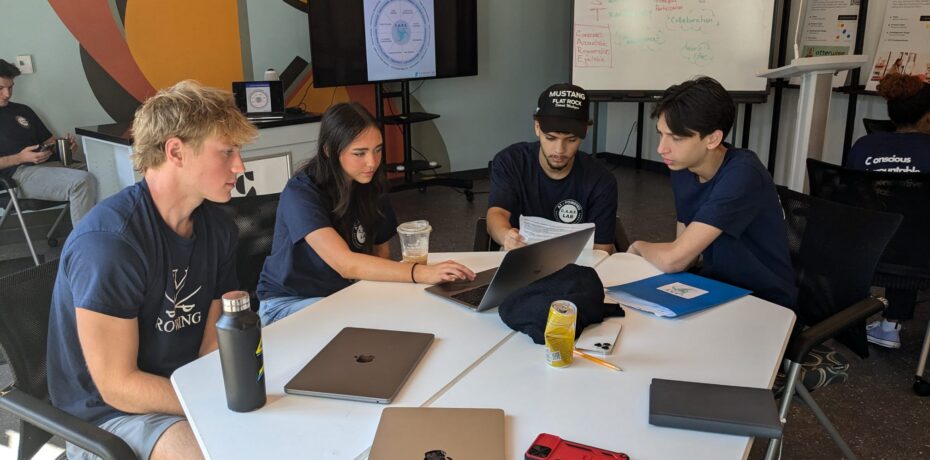
It is attempting to teach them how to navigate technology with empathy, judgment, and perspective intact. Inside collaborative classrooms and innovation spaces, students work directly on real-world challenges shared by local leaders and community organizations. Last year’s student cohorts explored issues ranging from homelessness and affordable housing to environmental equity and public art access through community challenge projects created alongside local civic leaders and nonprofit partners, including Charlottesville Mayor Juandiego Wade’s office.
This summer’s Charlottesville Mayor’s Challenge, “Cville 50,” will invite students to help reimagine the future of the Downtown Mall as the city celebrates its 50th anniversary, giving students a powerful voice and the agency to engage directly with stakeholders to address questions surrounding public space, culture, business, and civic identity. This summer, Richmond Mayor Danny Avula is also expected to participate in the Richmond program as the initiative continues to grow.
Students were not handed prepackaged answers. Instead, they were asked to listen, question assumptions, map unintended consequences, and design solutions capable of serving many stakeholders at once. One student team at UVA collaborated with the Blue Ridge Area Coalition for the Homeless to rethink approaches to transitional housing and long-term support systems.
AI played a central role throughout the process, though perhaps not in the way many people imagine. Stein is careful to distinguish CARELab from the growing wave of coding camps and productivity-focused AI workshops appearing across the country.
“We are using AI as a thinking partner,” she explains.
Students are encouraged to use the technology to challenge assumptions, explore unintended consequences, and think more deeply about the communities their ideas might affect. Stein often reminds students that “AI won’t replace leaders; it will amplify the conscious ones.”
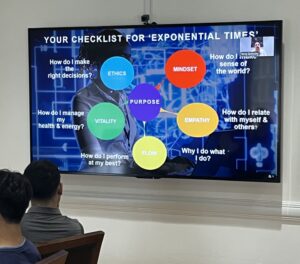
The organization refers to this approach through an increasingly resonant framework: HeartWare, MindWare, and TechWare. Emotional intelligence, systems thinking, ethical reflection, creativity, entrepreneurship, and AI fluency are treated not as separate disciplines, but as interconnected capacities future leaders will need simultaneously.
CARELab does not operate like a traditional classroom. “This is a roll-up-your-sleeves, hands-on experiential journey,” Stein says.
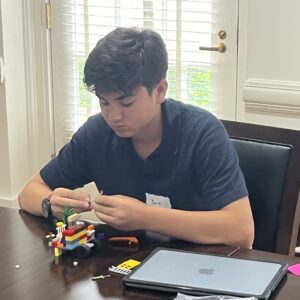
Students collaborate with entrepreneurs, civic leaders, futurists, nonprofit organizations, and mentors while developing proposals connected to real community challenges. Along the way, they participate in mindfulness exercises, systems-thinking workshops, venture development sessions, and collaborative design challenges that blend civic engagement with entrepreneurial thinking.
While much of today’s national conversation around AI revolves around fear of replacement, CARE360 takes a different posture entirely. The organization argues that the real opportunity is not simply using AI to move faster, but using it to think more holistically about people, communities, and long-term impact.
Its core framework centers around four principles represented by the acronym CARE: Conscious, Accountable, Regenerative, and Evenhanded. Students are encouraged to evaluate decisions through those lenses before asking whether an idea is scalable, profitable, or efficient.
Kaufman believes that distinction matters deeply.
“We are a capacity-building organization,” he says. “We expand the heart and the mind to work together using AI.”
According to CARELab’s 2025 impact report, every participating student reported gaining AI fluency, while nearly 90 percent reported stronger alignment with values, purpose, and entrepreneurial confidence.
One UVA student described arriving skeptical of AI, only to leave seeing it less as a shortcut and more as a tool capable of expanding perspective and creativity.
CARELab’s founders insist the program is not designed exclusively for elite students or families with financial resources. Scholarships and sponsored seats are intentionally built into the model because, in Kaufman’s view, financial barriers should never determine who gets access to meaningful leadership opportunities.
“We don’t want the friction to be money,” he says. “We want the friction to be purpose.”
Filling seats for the summer cohorts remains an immediate focus, with sponsored seats and scholarships currently available for both university cohorts this summer. The larger vision behind CARE360, however, stretches far beyond a single summer program.
Looking ahead, the founders plan to build a long-term pipeline of purpose-driven leaders capable of navigating the increasingly complex intersection of technology, business, and civic life. In their view, the next generation does not simply need AI tools for optimization – it needs an AI unlock, a wider framework for understanding how those tools can be used to expand our human capacity to shape human lives.
And perhaps that is the quiet optimism running beneath the entire project. Not the belief that technology will save us. But the hope that a generation raised amid complexity might also become uniquely capable of navigating it with wisdom, imagination, and care.
Students and families interested in learning more about this summer’s CARELab programs at the University of Virginia and the University of Richmond can explore program details, sponsored seats, and scholarship opportunities at CARE360.global/carelab.