

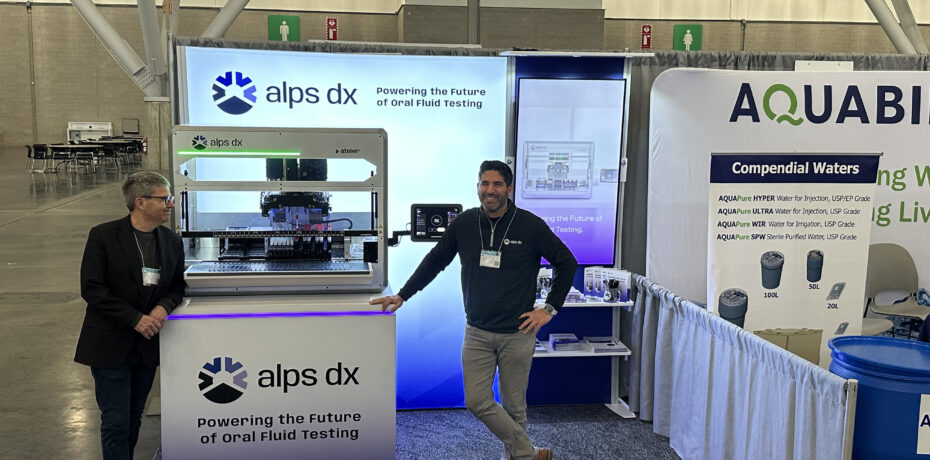
For decades, Les Edinboro worked in clinical and forensic toxicology, helping laboratories process thousands of drug screening samples each day. During his tenure at a leading clinical reference laboratory, he helped implement an oral fluid testing program that showed enormous promise for making drug testing more accessible and patient friendly.
Yet despite significant advances in the science behind testing, a stubborn obstacle remained. Much of the process that happens before a sample ever reaches analytical instruments continued to rely on manual handling, repetitive preparation steps, and inconsistent workflows.
“Oral fluid testing has long offered the potential for a more accessible and patient-friendly approach to toxicology,” said Les Edinboro, co-founder and Chief Scientific Officer of Richmond based Alps Dx. “Despite that promise, laboratories have continued to struggle with manual and inconsistent pre-analytical processes that require multiple handling steps and create delays, variability, and operational strain.”
After leaving the corporate laboratory environment, Edinboro began exploring ways to remove these barriers. Working alongside colleagues Greg Ourednik and Brian Sorel, he began developing a new approach to oral fluid sample preparation designed to automate one of the most labor intensive phases of testing.
The addition of entrepreneur Ali Safavi, founder of the Richmond-based breakout success Grenova, helped translate that technical vision into a scalable company. Together, the founders combined scientific, engineering, and business expertise to launch Alps Dx, a diagnostics automation company focused on improving the speed, efficiency, and scalability of oral fluid drug testing and related laboratory workflows.
Headquartered in Richmond, Alps Dx is focused on modernizing the pre-analytical phase of testing for its lab partners. These are the steps that occur between sample collection and laboratory analysis, where samples must be handled, prepared, and verified before they can be processed by analytical instruments.
Inspired by automation systems used in other industries, the Alps Dx team reimagined how oral fluid samples could move from patient to laboratory using connected technologies that reduce manual handling and improve consistency.
One of the company’s early systems, called Atelier, was designed specifically to address these workflow challenges.
“We built Alps Dx Atelier to address a critical gap in toxicology and forensic workflows for oral fluid drug screening,” said Safavi, President and Chief Executive Officer of Alps Dx. “Oral fluid testing could not fully reach its potential without a more efficient and standardized preanalytical process.”
The system automates tasks that laboratories have historically performed by hand, including sample identification, decapping, filtration, and preparation for downstream testing. By standardizing these steps, laboratories can reduce variability, improve sample quality, and increase operational efficiency.
For the founders of Alps Dx, the work ultimately comes back to the people who rely on testing results every day. Drug testing plays a critical role in healthcare, workplace safety, athletics, and more. Improving the earliest steps of the testing process helps ensure laboratories can deliver faster, safer, and more reliable results for the organizations and individuals who depend on them.
“Alps Dx will transform drug testing as we know it, replacing outdated, uncomfortable, and complicated sample collection with a clean, automated, and efficient oral fluid solution that removes major chain-of-custody obstacles and streamlines the entire process while eliminating user and process errors,” Safavi said.
As oral fluid testing continues to gain traction across healthcare and workplace settings, the Alps Dx team believes modernizing laboratory workflows will help unlock the full potential of the technology while making testing easier to administer and more reliable for the laboratories that process it.